


After all the fun of our summer Read With Us LOUNGE adventure, Bonny and Carole and I decided to try another something that is Read With Us adjacent, but maybe not as structured. We’re calling it Off the Shelf because once a month (usually on a Monday, but maybe not always on Mondays?) we’re each going to take a book . . . off the shelf . . . (our own shelves or maybe a library shelf or a bookstore shelf; who knows?) and share it with you. There won’t be a posting schedule for us, so . . . you’ll just have to expect the unexpected.
So.
Over the weekend, I was dusting (I know; don’t faint . . . ) and this book caught my attention.
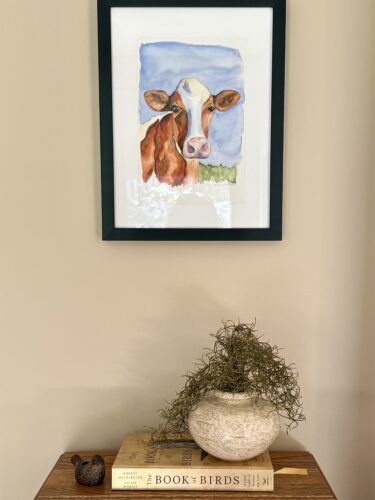
I took it (ahem) . . . off the shelf!
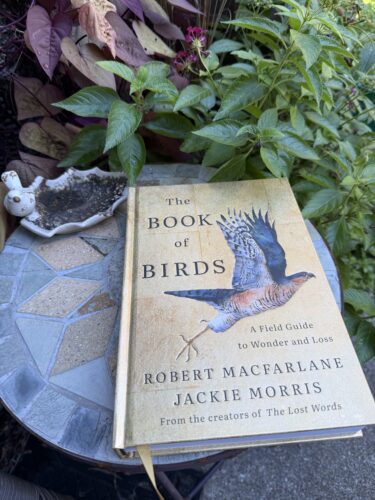
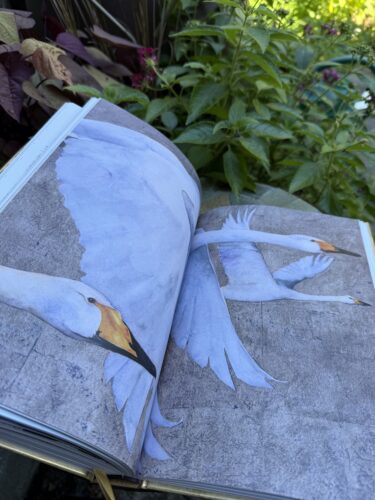
The book is The Book of Birds: A Field Guide to Wonder and Loss by Robert Macfarlane and Jackie Morris. In my home library, this book falls into one of my personal favorite categories of books: Books That Are Beautiful and Wonderful To Have Around. (Many of you will be familiar with the author and the illustrator of The Book of Birds, as they are the same team who brought us The Lost Words and The Lost Spells, two other Books That Are Beautiful and Wonderful to Have Around.)
The Book of Birds is a field guide, sure. But a most beautiful field guide that does much more than help readers identify birds . . . because it also helps readers identify with birds.
One of the underlying purposes of this particular “bird book” is to help us all understand what we are losing in the world . . . when we lose birds. (Which, sadly, we are. At a rapid rate.)
Robert Macfarlane writes endearing, essay-like entries for almost fifty bird species (and, yeah, a lot of the birds are European birds and not found in the U.S. but the message is universal and relevant so I don’t mind at all) that describe each bird’s habits and habitats, their feathers and beaks, their flight patterns, how they nest and raise their young, what they eat, when they sing, their myths, their threats, and – most importantly – how their lives intersect with our own.
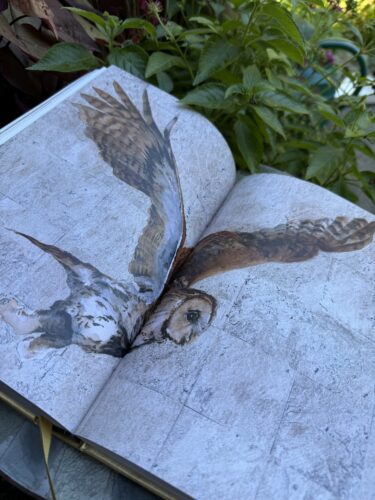
 And then Jackie Morris provides her exquisite watercolor illustrations that make me sigh and smile and want to frame them all for display in my upstairs hallway. Simply gorgeous paintings and elegant sketches . . . of each bird, their feathers, their eggs, their chicks, their nests, their lives. (True confession . . . I bought this book for the illustrations alone and consider the essays a Very Special Bonus.)
Truly. This is a beautiful, beautiful book!
Here are some words from the author and illustrator about their “why” in creating this book (taken from the Introduction to The Book of Birds) . . .
Though it has been created in an age of loss, at heart this is a book of hope. The art is intended as honouring and celebration; the words ae meant to be spoken aloud, as a form of conjuring back.
What is lost when birds are lost? Above all, the creatures themselves, in their own splendour and right. And for humans – language, story, beauty, possibility, imagination, lifts of the spirit, ways of being otherwise. Birds are our place-makers, memory-keepers, calendars and clocks. They stitch the world’s parts together: earth to sky, river to woodland, mountain to sea, country to country, hemisphere to hemisphere. Without them, things start to fall apart.
During the seven years we spent making The Book of Birds, the words of two writers guided us especially. The first was Bertolt Brecht’s observation from 1939: ‘In the dark times, will there also be singing? / Yes, there will be singing about the dark times.’ The second was the set of three instructions given in 2008 by the poet Mary Oliver: ‘Pay attention. Be astonished. Tell about it.’ Yes. This is what we have tried to do.
— Robert Macfarlane and Jackie Morris
I love having Books That Are Beautiful and Wonderful To Have Around – like The Book of Birds – in my personal library, on (and off!) my shelves. When the world seems hard and harsh and disappointing, it’s a treat to reach over and pick one up . . . to find beauty and wonder and hope inside once again.
Respite, indeed.

This particular book keeps coming across my path these days. Must be a sign that I should get it! I do love Macfarlane’s writing (Fletch and I are currently listening to one of his books) and Jackie Morris is a marvelous illustrator. Thanks for this post Kym.
What a beautiful book! That’s definitely a special one to have on your shelf (or on your coffee table, where it can be enjoyed).