


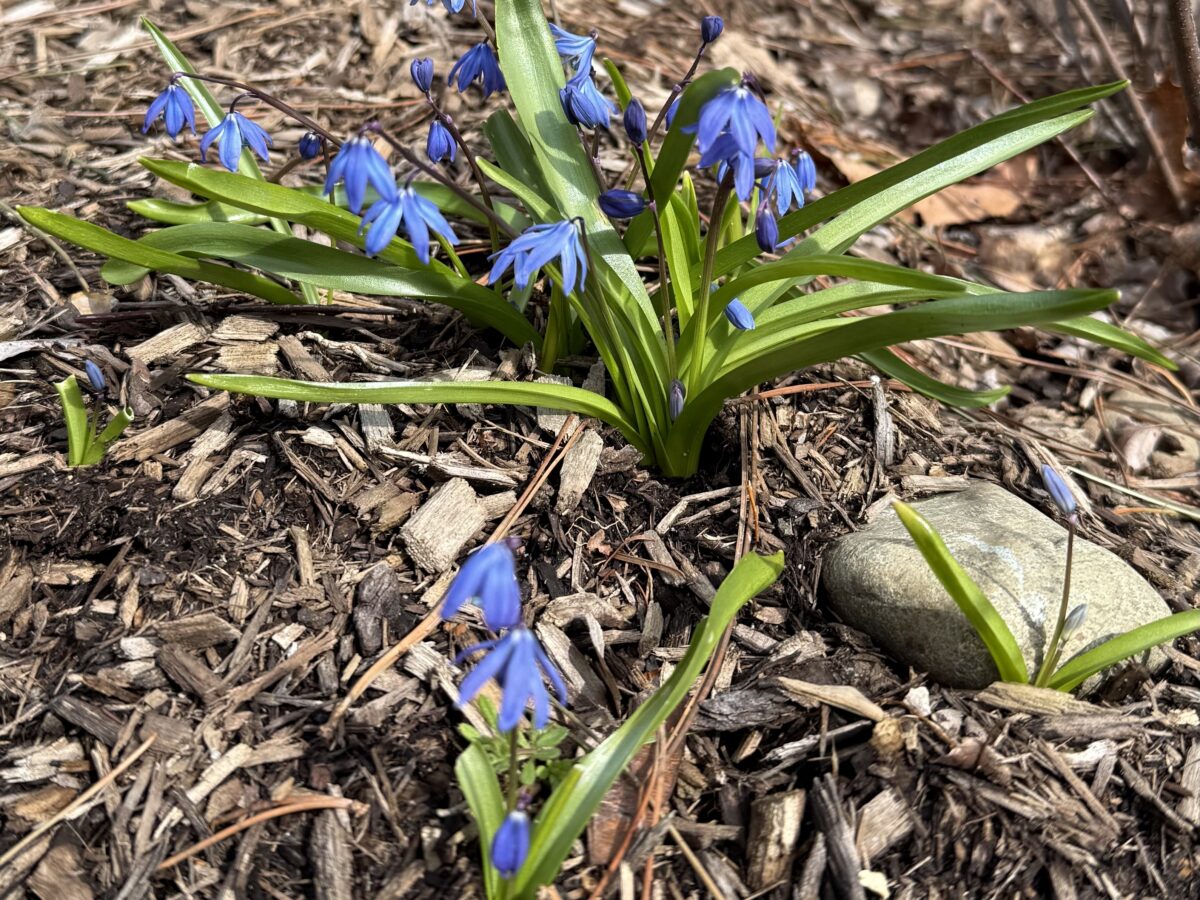
Isn’t this a sweet little Spring plant?
Yeah. I thought so, too.
But I’ve learned to . . . BEWARE . . . of sweet little plants that just show up – unbidden – in my garden. I mean . . . I didn’t plant this. But it’s been popping up like crazy in my garden beds over the last few years. It shows up in the Spring, creates these lovely little pops of bright blue, and then . . . POOF! It just disappears. Until the next Spring . . . when it brings back more and more of its friends.
Even though it makes me smile when it blooms, I’ve known for awhile now that it’s a non-native invasive plant here in Michigan. (But it’s so cute . . . ) And I know it will eventually become a Garden Thug. (But that blue is so dreamy after a long winter . . . ) And I know it’s really bad for woodland areas — and for neighborhoods that border woodland areas. (But really cute. . . )
This year, though, when I noticed a lot more of it in my garden than ever before — even popping up in the middle of my hellebores — I knew it was time to take action! It had definitely reached Thug-Stage and I needed to get serious about getting rid of it — despite the cuteness and the pop-of-blueness.
And because every once in a while, I go all Master Gardener on you, I’m going to bring you all along to share what I’ve learned.
So this cute little blue plant is officially known as Siberian Squill (Scilla siberica). It is a Known Thug and has been designated an invasive throughout the Midwest and Northeastern regions of the US and up into Canada. It’s cute, sure, but it will spread aggressively and choke out plants you WANT in your garden. And it is a particular threat to woodlands.
Where did it come from? Well, it’s a native plant in Russia (thus the “Siberian” part of its name) and Turkey, and was sold here as a garden plant for many years. (Shoot, what’s not to love? It’s winter hardy, it’s low-maintenance, deer and rabbits avoid eating it, and it’s so dang cute!) Where did it come from in my garden (and probably yours)? Birds, most likely. Ants (seriously). Or maybe it ducked under the fence from your neighbor. Or it could have hitched a ride in some plant that a friend shared from her garden.
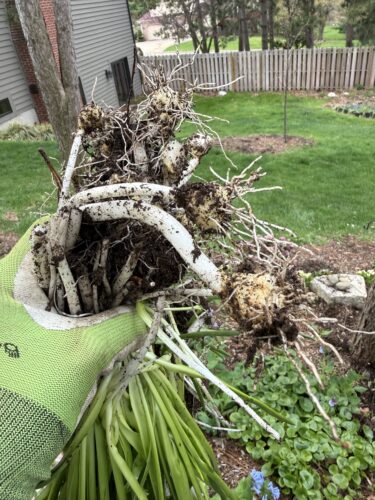 How to get rid of it? Well . . . that’s the tricky bit. It’s much easier to get rid of individual plants of Siberian Squill — before it starts to mat together in a thick garden carpet. The plant spreads in two ways. First, after it blooms, those cute little blue flowers create seed pods that spread above ground and are eaten/carried around by ants (and birds). Second, it forms bulbs under ground. And . . . you need to get rid of BOTH sources of spread — the seed pods AND the bulbs. Prepare to dig a bit. AND cut off the flowers while they’re blooming to keep those seed pods from forming.
Recently, I spent a long afternoon digging up the stuff, and then Tom took a turn last weekend digging up some more. I still have a few more spots to hit in the near future. We mostly had single plants and small clumps spread through our garden, but it was troublesome to deal with when it was intermingling with plants we DO want. My advice – get it whenever you see it, and don’t let it spread!
Bottom line here . . . Invasives are trouble. (And not all of them are cute.) Get rid of them at your earliest opportunity. Thugs . . . are thugs.
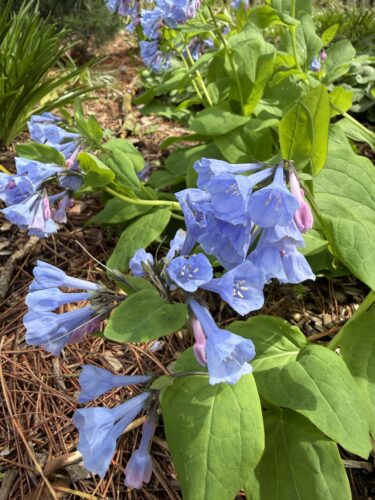 And if you’d like some healthy native plants that will provide beautiful pops of blue in your garden . . . I recommend Virginia Bluebells. They’re native throughout the Eastern half of the US and Canada, and naturalize beautifully in the garden — and always play nice. (They look great alongside hellebores, too. Just sayin.)
==========
And if you would like more information about Siberian squill – and how to get rid of it, check out this Instagram clip from a Chicago-area garden coach.
View this post on Instagram
It’s hard to believe that something that looks so pretty can be so terrible! That blue is beautiful and I know I’d be tempted to leave it if any popped up (which thankfully it hasn’t so far). Keep digging and death to invasive Siberian Squill!
Oh good luck with that! Sounds like the kudzu of the North! Maybe local news programs can warn people as a public service.
I’ve had squill for as long as I can remember between my yard and my father-in-law’s yard – mostly in his, though. I always loved seeing those blue flowers pop up in the spring until I realized it was BAD. Luckily, it hasn’t ever invaded my garden beds – maybe because it’s mostly in the lawn and Dale mows it down? And this year they’ve been doing a LOT of digging in the yard next door in preparation for the sale (which HALLELUJAH went through yesterday) and I haven’t seen any squill appear this spring. I’ll admit that I was a little sad about it (because it’s like another farewell to Jack) but I know that it’s actually a good thing if it’s gone even though I highly expect it to return next year. I suppose at this point it will depend on what the new owners do over there.
I tried to grow quill as a border near the mailbox by the front door. Mind you, this was years ago and I’m in the west.(?) Over the years it just slowly disappeared. I see it in small areas of other yards in the neighborhood and it never really goes beyond where it’s planted. I’m sure it spreads here, too, but I so rarely see it I think it might act differently here (lack of water?). Anyway, I love the color and I tend to notice anything blue. I’ve always loved it. Now I will be wary of ever planting it on purpose.
If it can be controlled by mowing, why is squill worse than some other imported spring flowers we grow i.e. tulips, peonies, daylilies and hellebores?
I don’t have time to research a full answer today, so this is me, shooting from the hip — and just “what I think.” Squill is an aggressive, non-native plant in the US. That means it crowds out beneficial natives in the wild. Natives are always preferred because they support the native ecosystem and are a good match for native species. (Invasives provide food — but it’s not as nutritious for native wildlife and pollinators; kind of like candy vs. veggies for humans.) So the main reason to eradicate an invasive plant like squill is to keep it out of woodland (or other wild) areas so native plants can thrive.
In terms of home gardening, most gardeners like to choose which plants they want in their spaces (tulips, peonies, daylilies, hellebores, etc.),and which ones they don’t (invasives). While none of those plants (except maybe the daylilies? like I said, I don’t have time to research this) are natives, they are also not aggressive and are not a problem in, for example, woodland areas. Tulips do not choke out native species, generally.
In terms of mowing the squill, yes, that can help to control seed production. But it doesn’t eradicate the plant. Those bulbs are still replicating underground, and the plants will come back.
I hope this helps. Although I’m always learning about gardening/natives/plants, in general, I’m no expert. I’m trying to incorporate more natives into my own garden — and I’m always on the lookout for invasives – to try to keep them out of my garden. (Even when they’re cute.) 😊
Thanks for your comment and your excellent question!
We’ve had Siberian squill popping up here & there… mostly among the snowdrops that cover the ravine in spring… so I always thought it was just a variant/mutant. Alas, not so! I doubt I’ll ever eradicate it down there, though. Ugh.